
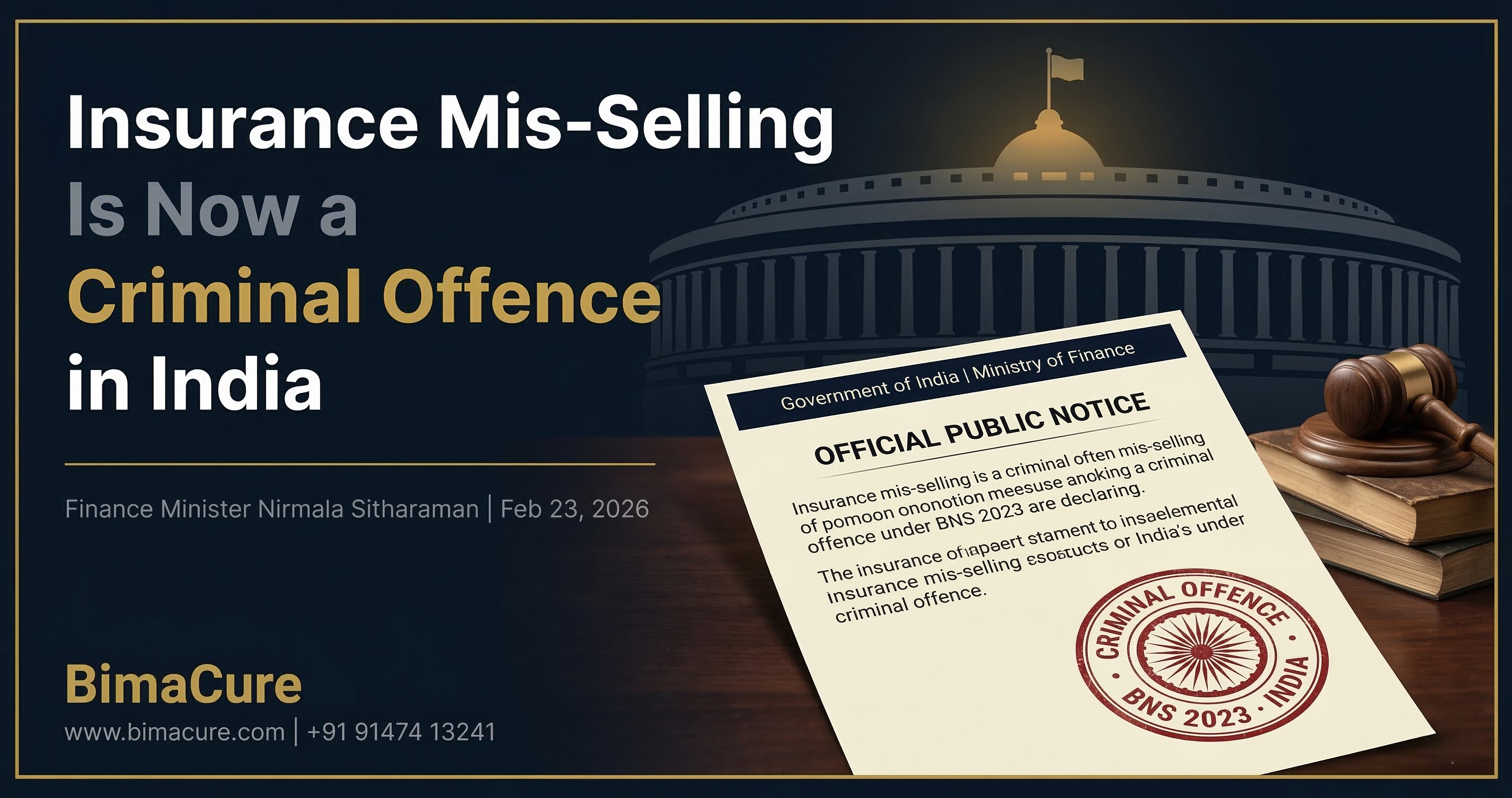
Finance Minister Nirmala Sitharaman declared on February 23, 2026 that insurance mis-selling is an offence under the Bharatiya Nyaya Sanhita (BNS). RBI's new rules effective July 1, 2026 require full refunds. Here is what every Indian policyholder needs to know.
On February 23, 2026, Finance Minister Nirmala Sitharaman addressed the media after the Central Board of the Reserve Bank of India's post-Budget meeting in New Delhi. What she said was not a routine announcement. It was a direct warning to every bank and insurance company operating in India.
She stated that mis-selling of financial products including insurance is an offence under the Bharatiya Nyaya Sanhita (BNS), India's new criminal law. She pointed out that banks were spending more time selling insurance than doing their core work of mobilising deposits and disbursing loans. She named the regulatory gap between RBI and IRDAI that had allowed this behaviour to continue unchecked for years. And she said that gap is now being closed.
"Banks should concentrate on their core business. My pet peeve has always been that you are spending more time on selling insurance when it is not required, and conveniently, it fell between two stools of RBI and IRDAI. The message should go to the banks that you cannot afford to mis-sell. Mis-selling is an offence... under Bharatiya Nyaya Sanhita."
Finance Minister Nirmala Sitharaman, February 23, 2026. Source: PTI / ANI (primary wire agencies) / Business Standard / The Tribune. All independently verified.
Editorial note: PTI and ANI confirmed the Finance Minister's statement that mis-selling is an offence under BNS. One editorial source noted she acknowledged some ambiguity about which specific BNS provisions apply in every individual case. Proceedings under BNS require case-by-case assessment by a qualified advocate. This article presents the statement as reported by primary wire agencies.Sumit, a business consultant, brought his wife to Manipal Hospital after a persistent fever. Star Health Insurance had verbally confirmed cashless treatment. The emergency doctor admitted her for over 48 hours on suspected dengue. Star Health rejected the claim three times, saying the hospitalisation was not medically necessary - even after Sumit submitted three written letters from the treating doctor. He paid Rs. 41,000 from his own pocket.
When official channels failed, he posted his experience on LinkedIn. The post went viral within hours. Star Health called the next day, apologised, and settled Rs. 36,000 of the claim. Not a single new document was submitted. What changed was that the company could no longer ignore the documented record of their own failure.
What this tells you: Insurance companies respond to proper documentation, consistent escalation, and formal pressure. You do not need to go viral. You need the right escalation path and someone who knows how to use it. That is what this article, and Bimacure, gives you.
Mis-selling happens when a bank, agent, or financial institution sells you a policy through any of the following methods:
The Finance Minister specifically raised the case of home loan borrowers. Her question was direct: if a borrower has already pledged their property as collateral, why is the bank also requiring them to buy insurance? The property is the guarantee. There is no valid justification for the additional requirement. This is mis-selling.
"If your property is already the guarantee for the loan, why should you be forced to buy insurance on top of that? There is no answer to that question."
Bank-led insurance mis-selling existed in a blind spot between two regulators for years. Here is how it worked:
| RBI | The Gap - Where Customers Suffered | IRDAI |
|---|---|---|
| Regulates banks but treated insurance sales as outside its domain | Customer fell between two regulators. Nobody accepted responsibility. | Regulates insurance but does not supervise how banks sell policies |
The Finance Minister named this gap publicly on February 23, 2026. The RBI issued draft directions on February 11, 2026 to close it permanently, effective July 1, 2026.
Bimacure has recovered over Rs. 16 crore in insurance claims for more than 12,800 clients across India. Get a free consultation today - no upfront payment required.
Talk to Our Legal Team - FreeOn February 11, 2026, the RBI issued its draft Responsible Business Conduct Amendment Directions, 2026 (Notification: DOR.MCS.REC.No./01-01-032/2025-26). These rules take effect from July 1, 2026.
| What RBI Has Mandated | What It Means for You |
|---|---|
| Full refund if mis-selling is proved | Every rupee back, with no deductions |
| Compensation for all losses caused | Interest, opportunity cost, and financial distress are all claimable |
| No forced bundling of products with loans | Insurance cannot legally be made a condition of your loan approval |
| Explicit recorded consent required for each product | A separate, written, verifiable agreement is needed for every product sold |
| Ban on dark patterns and digital manipulation | Hidden tick boxes and misleading online flows are now illegal |
| Marketing calls permitted only from 9 AM to 6 PM | Harassment calls at odd hours to pressure a sale are now prohibited |
| 30-day post-sale customer feedback check required | Banks must verify that you understood what you bought one month after purchase |
| Bank is liable for mis-selling by its agents | If an agent lied to you, the bank is now directly responsible - not just the agent |
| Suitability assessment required before every sale | Product must match your actual age, income, and risk appetite |
The Bharatiya Nyaya Sanhita (BNS) replaced the Indian Penal Code in 2023. The Finance Minister stated that mis-selling falls within its scope. This means deliberately deceiving a customer to sell a financial product is no longer just a regulatory violation. It can be treated as a criminal matter. BNS provisions on cheating, fraud, and obtaining consent by false representation all apply.
Until now, most affected policyholders were told to file a complaint with the insurer or approach the Ombudsman. That remains the right first step and is still the fastest path to a refund. But the law now gives victims an additional criminal route as well - a complaint can be filed with the police or a magistrate alongside the regulatory escalation.
If you were sold a policy you did not ask for, were not told the full truth about what it covers, or were pressured into buying it as part of a loan, you have the legal right to demand a full refund. As of 2026, this is backed by the Finance Minister, the RBI, and the criminal law of India.
Mis-selling does not happen randomly. Banks and agents target specific groups of customers:
Unfair business practice grievances in FY25, up 14% from prior year
(IRDAI Annual Report FY25)
Of all private sector insurance complaints came from unfair business practices
(IRDAI FY25)
Commission earned by banks from insurance sales in FY24 alone
(IRDAI data)
That Rs. 1,700 crore commission figure explains why customers faced relentless pressure at bank branches. It is also why the Finance Minister called this her "pet peeve" of many years.
If you believe you were mis-sold a policy, follow these steps in order. Do not skip steps. Each one builds the record that the next one requires.
Write to the Grievance Redressal Officer (GRO) of your insurance companySend a formal written complaint by registered post or email. Give them 15 days. Obtain written acknowledgment. Keep every document and proof of submission. Bimacure can draft this letter for your specific insurer.
Escalate to IRDAI via the Bima Bharosa PortalIf unresolved in 15 days, file at bimabharosa.irdai.gov.in or call the IRDAI consumer helpline at 155255. This is the official insurance regulator of India.
Approach the Insurance OmbudsmanCompletely free to file. Binding on the insurer for amounts up to Rs. 50 lakh. Award issued within 3 months. Insurer must comply within 30 days of the award. Find your nearest office at cioins.co.in.
File with the RBI Ombudsman if the policy was sold by a bankThe bank is now directly responsible for any mis-selling by its agents. File on the RBI Integrated Ombudsman portal. See how Bimacure handles bank-sold policy cases.
Consumer Forum for amounts above Rs. 50 lakh or systematic fraudFile at the National Consumer Disputes Redressal Commission (NCDRC) or West Bengal State Consumer Commission. File online at edaakhil.nic.in under the Consumer Protection Act 2019.
Police or Cyber Crime Portal if intentional fraud is involvedFile at cybercrime.gov.in and your local police station. Reference BNS provisions on cheating and obtaining consent by deception.
| What Must Happen | Mandated Deadline |
|---|---|
| Insurer must acknowledge your complaint | 3 working days |
| Insurer must resolve your complaint | 15 days |
| Claim settlement or rejection must be communicated | 30 days from final document submitted |
| Delay penalty payable by the insurer | 2% above bank rate per annum |
| Insurance Ombudsman must issue its award | Within 3 months |
| Insurer must comply with the Ombudsman award | Within 30 days of the award date |
Bimacure publishes verified IRDAI updates, Supreme Court rulings, and RBI directives that matter to policyholders. No spam. One email when something changes.
Your data is protected under the Digital Personal Data Protection Act 2023. Unsubscribe any time.
"LIC rejected my husband's death claim citing non-disclosure. Bimacure filed a formal legal notice, cited the moratorium clause, and the claim was settled in full within six weeks. I did not have to attend a single hearing."
Pratima Ghosh, Widow of policyholder, Howrah, West Bengal
"HDFC Bank sold me a ULIP alongside my home loan without explaining what it was. Bimacure recovered the full premium paid over three years. I was told it would take a year. It took four months."
Subhajit Mandal, Government employee, Durgapur, West Bengal
Share this article and help someone know their rights:
WhatsApp LinkedIn Facebook TwitterTags:
Insurance Mis-Selling Claim Rejection IRDAI 2026 RBI Rules Consumer Rights Free Look Period BNS InsuranceIs insurance mis-selling a criminal offence in India?
Finance Minister Nirmala Sitharaman stated on February 23, 2026 that mis-selling is an offence under the Bharatiya Nyaya Sanhita (BNS). Deliberate deception to sell a policy can attract criminal liability alongside regulatory penalties. Case-specific legal advice from a qualified advocate is required to determine which BNS provisions apply.
Can I get a full refund if I was mis-sold an insurance policy?
Yes. Under RBI Draft Directions 2026, effective July 1, 2026, banks and insurers must refund the entire amount paid if mis-selling is proved and must also compensate for any additional financial losses caused, including interest and opportunity cost.
Can a bank force me to buy insurance when I take a home loan?
No. Making insurance a compulsory condition of a loan is illegal. The Finance Minister specifically raised this issue on February 23, 2026. RBI's 2026 draft directions explicitly prohibit this practice under the ban on forced product bundling.
What is the free-look period and how do I use it?
The free-look period is 15 days from the date you receive your policy document, extended to 30 days for policies sold online or by distance. During this window you can cancel the policy with no questions asked and receive a full refund of the premium paid. Not being informed of this right is itself a form of mis-selling.
How do I file a mis-selling complaint in India?
Write to your insurer's Grievance Redressal Officer first. If unresolved in 15 days, file at bimabharosa.irdai.gov.in or call 155255. Then approach the Insurance Ombudsman at cioins.co.in. For bank-sold policies, also use the RBI Integrated Ombudsman. For consumer court, file at edaakhil.nic.in. Bimacure handles this entire process on your behalf.
 BimaCureYour Trust Our Priority
We specialize in providing independent grievance redressal legal services. We are not an insurance company, broker, or intermediary registered with the IRDAI. We assist clients with insurance policy complaints by handling all documentation, communication, and legal support.
Corporate office : Merlin Infinite DN-51, Suit-603 Street No 11, DN Block, Sec V, Bidhannagar, Kolkata, WB 700091
Registered Office : 2A, Ganesh Chandra Avenue, Commerce House, 7th Floor, Room - 6A, Kolkata -70001
Bimacure.com is not related to IRDA/Ombudsman in any manner.© 2025 Copyrights by INSUCURE Solutions India (OPC) Pvt. Ltd. All Rights Reserved
ISO - 9001:2015 | ISO/IEC 27001:2022 | CIN - U70200WB2024OPC271472
Design & Develop by Webina Tech

